Professional
Career goals, skill development, workplace relationships, and project ownership.
A structured, non-clinical approach to aligning professional commitments with personal priorities. This framework is presented as general educational content for self-directed learning or guided coaching sessions.
Integration replaces the outdated notion of perfect balance — instead, we seek conscious trade-offs that reflect your values at each life stage.
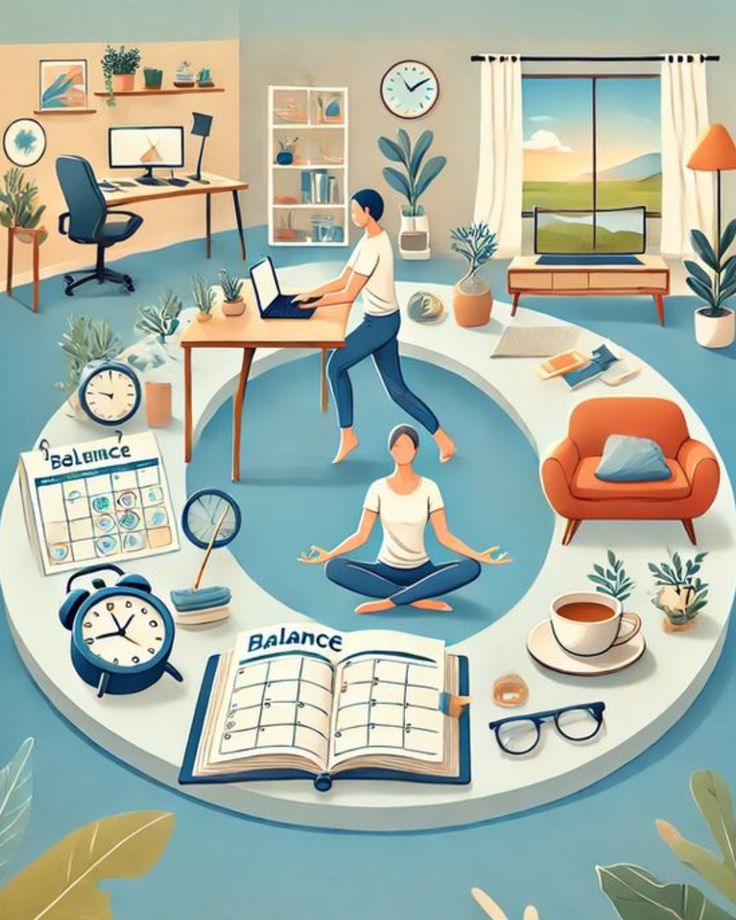
Before adjusting habits, it helps to assess where your time and attention currently flow. Our Equilibrium Assessment covers four interconnected dimensions, each scored through self-reflection rather than external evaluation.
Career goals, skill development, workplace relationships, and project ownership.
Family connections, friendships, hobbies, and solo restorative activities.
Movement, nutrition awareness, rest routines, and environmental comfort.
Learning pursuits, creative expression, mindfulness practices, and personal reflection.
A visual self-reflection exercise used in our coaching programmes to identify areas receiving adequate attention versus those needing adjustment. Responses are personal reference points, not diagnostic scores.
Assign a satisfaction score from one to ten for each of the four dimensions based on your honest self-perception over the past month.
Compare scores across dimensions. Significant disparities often indicate where small structural changes could create meaningful shifts in daily experience.
Choose a single dimension for a four-week adjustment experiment. Narrow focus can make routine changes easier to maintain than broad overhauls.
Define and communicate your response windows for email and messaging. Templates in our resource library help phrase boundaries professionally without creating conflict.
Example phrasing: "I review messages between nine and five on weekdays and respond within one business day." Clarity reduces ambiguity for colleagues and clients alike.
Personal transition cues signal the end of work mode. Changing clothing, a brief walk, or a dedicated shutdown checklist helps compartmentalise professional concerns.
Household members benefit from understanding these rituals. Shared agreements about quiet hours and device usage create supportive environments for everyone.
Many professionals struggle with guilt during downtime. Reframing rest as productive maintenance — not laziness — is a recurring theme in our coaching conversations.
Scheduling rest with the same seriousness as meetings reinforces its legitimacy. Block calendar time for walks, reading, or unstructured leisure without justification.
Complete the Equilibrium Assessment and set three measurable objectives for the programme duration.
Track how hours are spent across a full week. Identify patterns and unexpected time sinks.
Implement and test one workplace and one personal boundary. Document outcomes in your journal.
Align demanding tasks with preferred working periods. Reschedule lower-priority items accordingly.
Consolidate learnings into a sustainable personal playbook for ongoing self-management.
A forty-page printable guide with assessment templates, weekly planners, and reflection prompts updated quarterly.
Twelve guided ten-minute sessions covering topics from delegation to evening transitions, recorded in a calm conversational tone.
Facilitated group conversation frameworks for programme participants who wish to share experiences in a structured format.
Quarterly planning calendars aligned with New Zealand public holidays and typical corporate cycles.
Yes. The Equilibrium Model scales to various responsibility levels. Senior professionals often focus on delegation and strategic time allocation modules within the framework.
No prior experience is needed. Materials are written for independent comprehension, and coaching sessions provide additional context for those who choose guided support.
Outcomes depend on individual circumstances, consistency, and external factors. We make no promises regarding specific results. The framework provides tools and structure; application is your responsibility.
Contact our Auckland team to learn about programme enrolment, individual coaching sessions, or access to the digital resource library.